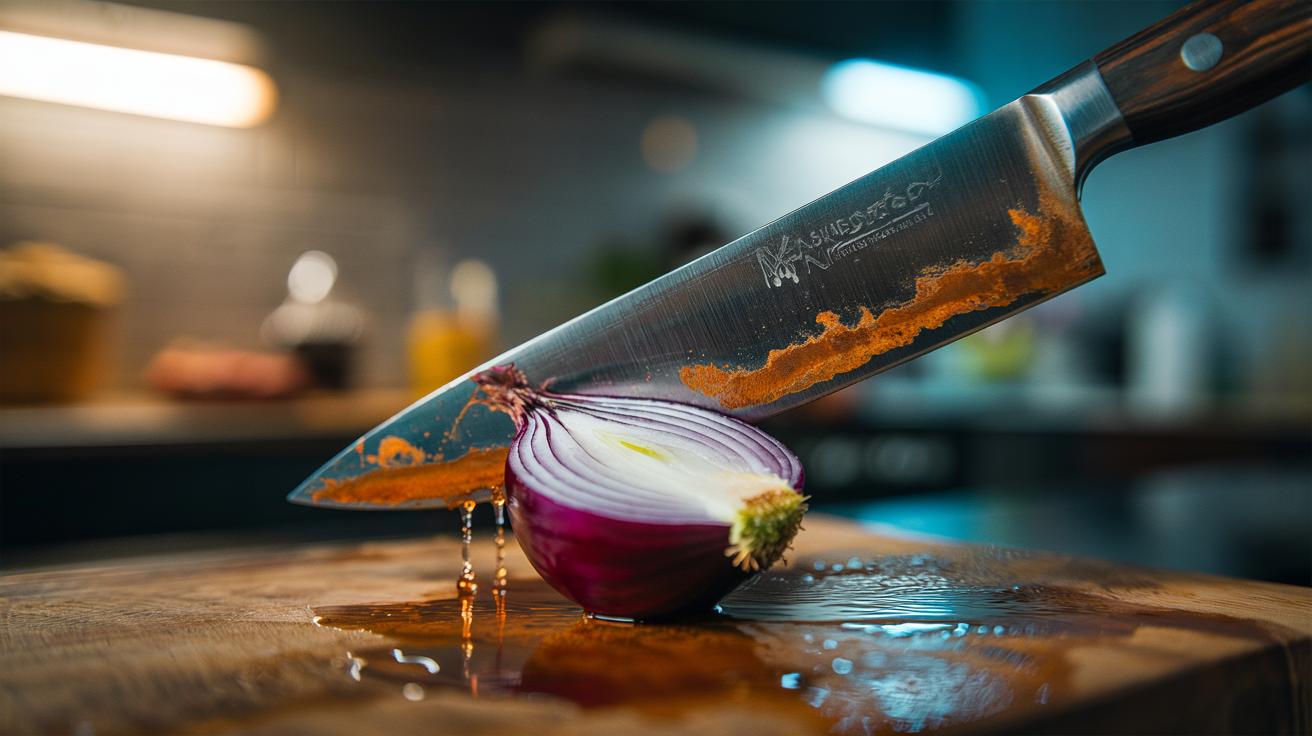
In a nutshell
- 🔬 Onions contain mild acids and reactive sulfur compounds that loosen iron oxide (rust), targeting corrosion more than sound steel.
- 🧅 Method: halve an onion, stab and draw the blade 10–20 times, leave a thin film for 1–3 minutes, then wipe, rinse, dry, and finish with food-safe oil.
- 👀 Results: orange rust smears and darkens before wiping away; carbon steel may develop a protective patina, while deep pitting won’t be reversed.
- ⚠️ Limits: avoid on delicate coatings, don’t let acids dry on steel; escalate to vinegar, lemon, or fine abrasion only for stubborn corrosion.
- 🛡️ Prevention: dry knives immediately, store with silica gel, and use the onion clean as quick, gentle maintenance; the article includes a table comparing household rust removers.
An onion, a chopping board, and a spot of patience. That’s all you need to turn a speckled blade into a smooth, serviceable tool again. The kitchen staple isn’t just for stews; its juice carries mild acids and reactive sulfur compounds that nibble at rust while you work. Slice, stab, twist. With each pass, you’re staging a small chemistry show at the bench. Because the reaction is gentle, you’re less likely to scar the steel compared to harsh cleaners. What you see next feels satisfyingly direct: orange oxide smears, darkens, lifts, and wipes away. No solvents. No stink of heavy chemicals. Just a bulb, a blade, and a little know‑how.
Why an Onion Lifts Rust From Steel
Onions sit in a sweet spot of kitchen chemistry. They’re not caustic, yet they’re not neutral either. Their juices hover around a pH that’s mildly acidic, rich in sulfur-based molecules formed when the cells are cut. Those compounds, alongside naturally occurring organic acids, interact with the flaky layer of iron oxide that we call rust. In simple terms, they help loosen the oxide’s grip, while water in the onion juice keeps everything mobile enough to wipe away. Mild acidity favours the rust over the sound steel beneath, so the effect is surprisingly selective.
Mechanics matter, too. The onion’s slick juice reduces friction, while the blade’s repeated passes through the bulb provide light abrasion. Think of it as a lubricated polish: the rust dissolves a little, then gets swept off by the knife’s motion and the fibrous onion flesh. On stainless steel, whose chromium-rich surface naturally resists oxidation, the onion helps refresh the passive layer once the oxide is removed. On carbon steel, you may see a darker patina forming—a desirable, protective finish for many cooks and makers.
Step-by-Step: Use an Onion to Clean a Rusty Knife
First, check the blade. If the rust is light—dusting, specks, a faint orange bloom—the onion trick is ideal. Avoid this method on coated or decorative finishes you’d hate to dull. Grab a firm onion and halve it to expose plenty of juice. Wipe your knife free of crumbs or oils so the acid can meet the metal without interference.
Now the action: stab the edge into the cut face of the onion and draw it out in smooth strokes. Repeat 10–20 times. Work along the full length, heel to tip. Then switch to the flat faces—press the blade gently against the onion, slide, twist, and lift. You’re aiming for a thin film of onion juice across the rusty zones. Let it sit one to three minutes, not longer. Do not leave acidic juice drying on steel for extended periods.
Wipe with a soft cloth. If orange staining persists, repeat the cycle. For stubborn specks, add a pinch of fine salt to the onion’s surface and scrub lightly with a cloth over the juice—an extra bit of mechanical bite. Rinse under warm water, then dry thoroughly. Finish with a smear of food-safe oil to protect the clean surface from fresh air and moisture.
What You’ll See: Quick Chemistry, Real-Time Results
Watch closely. The bright orange freckles soften first. They smear, turning brownish, sometimes even black, as the oxide breaks down and mixes with the onion film. That slurry wipes away, revealing a clearer surface underneath. On carbon steel, a subtle grey-blue may remain—a thin patina that actually helps future rust resistance. That colour shift isn’t damage; it’s a sign the surface is settling into a more stable state.
Feel and sound change, too. A squeaky drag becomes a silkier glide as the pits lose their bite. Odour cues help: the sharp, sulphury tang you smell is part of the reaction cocktail doing the work. If you spot dark, etched-looking patches that don’t budge, that’s past rust—pitting. The onion won’t rebuild metal. But it will clean the margins and stop the spread, giving you a better baseline for sharpening, polishing, or storage.
Limits, Risks, and Smarter Alternatives
Every remedy has a ceiling. Heavy, flaky corrosion or deep pitting needs escalation—careful abrasion with a fine scouring pad, a rust eraser, or a controlled soak in a stronger household acid. Match the method to the blade: less for delicate finishes, more for workhorse tools. If your knife carries a protective coating, any acid, onion included, may dull or patch it; test on a small area first. And always neutralise: a rinse, a dry, and a light oil keep oxygen and damp from undoing your work overnight.
| Household Aid | Typical pH | Speed on Light Rust | Risk to Finish | Notes |
|---|---|---|---|---|
| Onion | ~5–6 | Moderate | Low | Gentle; good for routine touch-ups. |
| Vinegar (acetic) | ~2–3 | Fast | Medium | Works quickly; can dull shine if overused. |
| Lemon (citric) | ~2 | Fast | Medium | Effective; rinse promptly to avoid etching. |
| Bicarbonate paste | ~8–9 | Slow | Low | Good for neutralising after acid clean. |
When in doubt, try the onion first; step up only if needed. If rust returns quickly, review storage. Dry the knife after washing, avoid leaving it in damp racks, and add a silica gel sachet in the drawer. Prevention always beats restoration.
A humble onion can rescue a blade in minutes, sparing you harsh chemicals and heavy abrasion. The trick lies in timing, touch, and a clean finish: short contact, controlled strokes, thorough drying, and a whisper of oil. It’s cheap, satisfying, and it works best as routine maintenance rather than last-ditch salvation. The next time orange specks bloom, you’ll have a quick fix and a story for the table. Will you keep an onion by the knife block and turn a kitchen staple into your most approachable rust remover?
Did you like it?4.5/5 (24)